
OUR PEOPLE FIRST
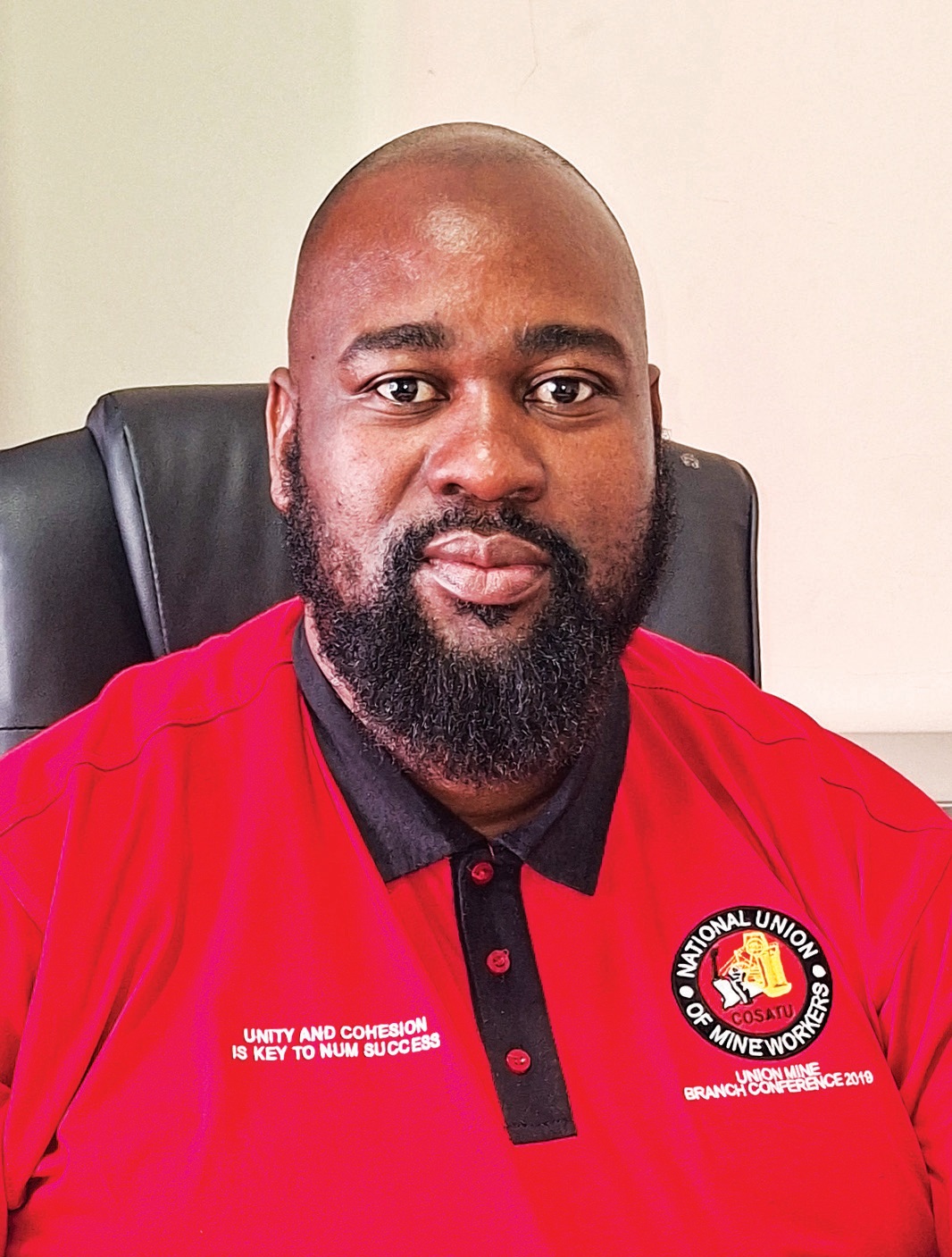
NUM Rustenburg regional chairperson July Radibe calls for responsible investment, meaningful participation and greater opportunities for all South African workers and businesses.
Platinum Weekly newspaper | Rustenburg – NUM Rustenburg regional chairperson July Radibe says South Africa needs mines and industry to succeed, but success must translate into jobs, opportunities, skills and a meaningful place at the table for all South Africans.
That is the message from National Union of Mineworkers (NUM) Rustenburg regional chairperson July Radibe – not only to mining houses, but also to major companies, contractors and decision-makers operating across South Africa’s mining, energy, construction and metal sectors.
Radibe is unashamedly pro-business. He wants mines, the energy sector and construction sector to operate productively. He wants projects to succeed, businesses to make profits and new investment to enter South Africa. Because without successful businesses there can be no sustainable jobs.
But, he says, South Africans should not be spectators while major projects are developed around them. “Let South Africans with the right skills get the contracts. Let the contractors employ South Africans,” Radibe told Platinum Weekly.
For him, responsible sourcing should go further than checking where materials and equipment come from and how operations affect the people around it. It should also ask who receives the contracts, who gets the jobs, who is being developed and whether contractors and subcontractors are meeting their obligations in South Africa.
Taxes matter too, he says. Mining houses and major institutions cannot demand accountability from their suppliers on one hand while turning a blind eye to contractors who fail to meet their tax and employment obligations on the other. Those taxes, after all, are what South Africa needs to fund schools, policing, roads, housing and infrastructure.
REAL participation
Radibe has become a familiar figure at negotiations, demonstrations and disputes involving some of the biggest employers in the Rustenburg region. His approach is based on something deceptively simple: people cannot complain afterwards about an outcome if they did not do everything reasonably possible to participate and change that outcome while they still had the opportunity.
That requires REAL participation… not consultation merely to tick a box, but actual conversations, actual negotiation and a genuine willingness by all sides to listen to and consider the opinions and options of the other party or parties.
Radibe says his own roots are in the mining industry. He came through Anglo American Platinum, which supported his studies, and after completing his engineering studies he worked in the industry. It was there that his interest in organising and representing his fellow workers developed, eventually leading him to his present position in the NUM.
The relationship between organised labour and big business has also matured, he says. Unions increasingly recognise that companies must remain viable, productive and competitive if jobs are to survive.
At the same time, responsible companies increasingly understand that organised labour is not simply an obstacle to business, but an important stakeholder. That relationship becomes particularly important when jobs are threatened.
The history of the Rustenburg mining belt has taught painful lessons about what can happen when trust collapses and people believe their voices are not being heard. Radibe invokes the memory of Marikana not to equate every labour dispute with that tragedy, but as a reminder of why transparency, dialogue and genuine participation matter.
NUM’s mission statement reflects the wider role the union now sees for itself: “The National Union of Mineworkers (NUM) is a labour organisation that recruits, organises and advances the interests of all workers employed in the mining, energy, construction and metal sectors and allied industries by empowering its members through quality services.”
Bakubung: jobs on the line
Those principles are now being tested at Bakubung Platinum Mine near Ledig. Bakubung is the flagship operation of JSE-listed Wesizwe Platinum. Wesizwe describes the mine as having an expected 30-year life of mine and openly acknowledges the considerable influence of its Chinese consortium shareholder, Jinchuan Mining and the China-Africa Development Fund, on the company’s strategy.
Bakubung Platinum Mine is owned by Wesizwe Platinum Limited, which is a JSE-listed South African company, which is owned by its controlling/ major shareholder which is Chinese-linked. Wesizwe itself describes this as its Chinese consortium shareholder, made up of Jinchuan Group and the China-Africa Development Fund (CAD Fund), with the balance held by other South African and institutional shareholders.
Chinese funding nevertheless plays a critical role. Wesizwe’s audited 2025 financial statements recorded material uncertainty over the group’s ability to continue as a going concern and said its future was dependent on continued financial support from Jinchuan Group (Hong Kong) Resources Holdings Limited.
Against that background, Wesizwe announced in June that it would abandon its previous 1-million-tonne-a-year production strategy and instead pursue a single-stage ramp-up towards a future 3.5 Mtpa operation. The restructuring accompanying that decision could affect approximately 497 employees out of a workforce of 706. For Ledig and surrounding communities, those are not merely numbers on a SENS announcement. They represent households, school fees, food on tables and money circulating through local businesses.
On Thursday, 27 August 2026, NUM’s Rustenburg Region, the Ledig Traditional Office and community members marched against the proposed retrenchments at Bakubung and handed a memorandum to mine management. It followed months of uncertainty. Operations were temporarily shut down in June during the Section 189A consultation process, followed by a phased restart. On 31 July, Wesizwe again temporarily suspended mining operations after employee feedback sessions and a gathering of workers at the mine, saying safety and security risks had increased to an unacceptable level.
Serious allegations
Radibe’s concerns extend beyond the number of threatened jobs. He says that Chinese personnel and contractors exercise disproportionate influence at Bakubung and questions whether South African managers always have the authority their job titles would suggest.
He further alleges that Chinese personnel are being protected from the effects of the restructuring while South African workers carry the brunt of the proposed job losses. Radibe also raises concerns about procurement and contracting, claiming that significant opportunities and purchasing are directed towards Chinese suppliers and contractors instead of being used sufficiently to develop South African capacity.
He questioned the use of an accommodation complex at the mine, which he says was originally presented as employee accommodation but is predominantly occupied by Chinese personnel and visitors. “They have Chinese chefs at the complex, preparing food for the Chinese employees and their visitors,” Radibe alleges.
These are serious allegations.
Platinum Weekly has not independently verified these claims and has afforded Bakubung Platinum Mine/ Wesizwe Platinum an opportunity to respond.
There is, however, independently verifiable Chinese involvement in Bakubung’s development. Wesizwe has previously contracted Chinese companies for various aspects of the project, and in 2025 confirmed that Sinosteel had been brought in to assist with rectification work on defects identified in the concentrator plant.
Radibe stresses that NUM is not calling for Bakubung to close. Quite the opposite. NUM wants the mine to succeed. But, he says, it must become the kind of responsible contributor that South Africans should be entitled to expect from a major mining operation: one that complies with employment and transformation requirements, develops South African skills, gives capable local businesses a fair opportunity and meaningfully engages with the people whose lives are affected by its decisions.
NUM and AMCU
Radibe also rejects the idea that organised labour’s different banners automatically make unions enemies. He says NUM and the Association of Mineworkers and Construction Union (AMCU) may compete for membership and may disagree on issues, but fundamentally they are fighting many of the same battles. Workers’ livelihoods, safety, fair remuneration and dignity do not change according to the logo on a union shirt. At Bakubung, both unions are recognised labour representatives. Wesizwe announced in July that an agreement had been reached with AMCU, while NUM continued operating under an existing peace agreement signed in February 2024.
When a mine reaches the end
Radibe’s concerns about accountability do not end while a mine is producing. When the life of mine eventually runs out, mining companies remain responsible for rehabilitation. He believes abandoned workings, open shafts and infrastructure left underground can create opportunities for illegal mining and theft long after formal operations have ceased.
In the Rustenburg area, he says, part of the illegal underground activity involves people entering old workings to recover valuable material such as copper cable and other infrastructure left behind. His message is that rehabilitation cannot be treated as an afterthought. Financial provision for rehabilitation must be protected, oversight must be credible and companies must be held accountable for leaving mining areas in a safe condition once operations end.
Radibe also believes South Africa must have a more nuanced conversation about illegal mining. While organised criminal mining must be dealt with, he believes there may be small-scale operators who could potentially be brought into a lawful, regulated system with the right government support – provided they meet the same fundamental safety and tax requirements expected elsewhere in the industry.
Small mine, same worker
The same principle applies to the growing number of smaller mining operations and contractors. A worker does not lose the need for protection because the company employing him or her is small. Radibe says even where a mining operation employs only a handful of people, those workers should still be able to organise and seek representation. Small mining businesses should pursue opportunities, he says.
“We are pro-business. We want operations to be productive and make profit, which is positive towards employment. South Africa needs to create jobs.” But growth, the effect on the community and worker protection cannot be treated as separate items. For Radibe, these issues must go together.
South Africa needs investment. It needs mines, it needs electricity, it needs construction. It needs contractors. It needs entrepreneurs. And it desperately needs businesses that are profitable enough to create long-term employment.
But the people living in the area, and the people working in these sectors must see the benefit.
That is the line NUM says it intends to hold: Business must flourish, be transparent and put people first – and South Africans must not be left standing outside the gate.
NUM Rustenburg contact: 014 597 2615
Theresia Asein: tasein@num.org.za
July Radibe: jradibe@num.org.za
BAKUBUNG PLATINUM MINE RESPONSE
Bakubung Platinum Mine has noted the article to be published by Platinum Weekly and the views expressed by NUM Rustenburg regional chairperson July Radibe. The Mine recognises organised labour as an important stakeholder and remains committed to constructive engagement, responsible business practices, transformation and meaningful participation by South Africans in the mining industry. While we respect the right of stakeholders to raise concerns, a number of assertions contained in the article are presented as allegations and have not been independently verified.
The Mine does not believe it would be constructive to debate these matters extensively through the media.
Bakubung Platinum Mine remains committed to conducting its restructuring and operational processes within the applicable legal and regulatory framework, while engaging affected employees, organised labour and relevant stakeholders through the appropriate established processes.
Our immediate focus remains the safe and sustainable operation of the Mine, organisational stability and ensuring that Bakubung continues to contribute meaningfully to its employees, surrounding communities and the broader South African economy. We remain available to engage constructively with our stakeholders through the appropriate channels.